
Ecommerce website development
E-commerce Dream Team: Roles and Responsibilities in 2026

Divyesh Kachhadiya
 08, July, 2026
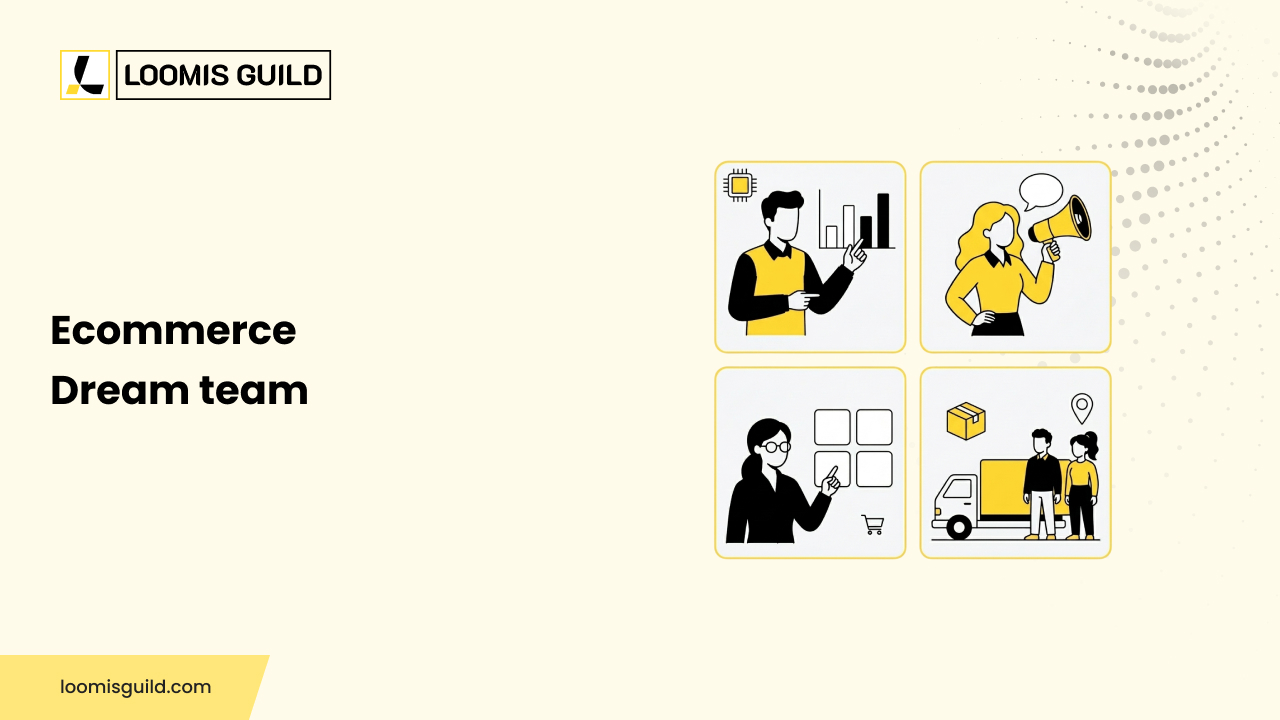
Ecommerce website development
Divyesh Kachhadiya
08, July, 2026
Let’s discuss how Loomis Guild can design and scale an eCommerce experience built for long-term growth. Start a conversation with Loomis Guild and take the next step toward a refined, scalable eCommerce platform.
"*" indicates required fields
Divyesh Kachhadiya
Divyesh is an Ecommerce Expert with custom store builds, theme development and migration. He is experienced Ecommerce developer sharing his insights for the ecommerce store development.
Quick Summary: An e-commerce dream team is the mix of leadership, technical, marketing, and data talent that keeps an online business running and growing. Team structure matters in 2026 because AI has changed what each role does day to day. Priorities for most businesses: a strong e-commerce leader, a developer who knows the platform, a marketer who blends SEO with AI search visibility, and someone who owns data and automation. AI hasn't removed the need for people. It has shifted their work toward strategy and the judgment calls machines still can't make.
Ask ten online business owners who actually run their store, and you’ll get ten different answers. Some rely on one generalist juggling product listings and customer emails. Others have built out departments with specialists in every corner of the operation. Both setups can work depending on the business. What’s changed over the past two years is what each role is responsible for.
AI agents now influence how products get discovered, how customer questions get answered, and how pricing decisions get made. Deloitte’s 2026 Global Retail Industry Outlook found that AI-driven chat tools already account for 15% to 20% of total referral traffic for some retailers, with some estimates suggesting AI agents could influence a quarter of global B2B e-commerce stores sales by 2030. That hasn’t eliminated jobs. It has changed what they require.
This guide breaks down the roles that make up a capable e-commerce team in 2026 and how to decide which ones belong in-house versus with an outside partner.
An e-commerce dream team is the group of people, whether employees, freelancers, or agency partners, who collectively cover strategy, technology, marketing, operations, and data. There’s no single template. A direct-to-consumer brand in Austin might need three hires and a development partner. A B2B Ecommerce development company in Manchester might need a larger internal team for complex catalog and pricing logic.
What’s changed is the shape of the team, not whether one exists. Tasks that used to be manual, like writing product descriptions or pulling sales reports, are increasingly handled by AI under human supervision. Those roles now spend more time reviewing AI output and handling exceptions AI can’t resolve alone. McKinsey describes assistant-level roles evolving into “intelligence integrator” positions that validate AI models and turn data into decisions, rather than simply generating reports by hand.
Leadership in e-commerce generally falls into three categories: strategic, operational, and technical.
The E-commerce Director or Head of E-commerce owns the P&L for online sales, sets growth targets, and decides where the budget goes. In larger organizations, this role sits under a Chief Digital Officer or Chief Commerce Officer overseeing digital strategy for the whole business.
E-commerce Product Manager bridges business goals and what the site or app actually does, prioritizing features and working with developers to make sure changes move the needle on conversion or retention.
Operations Lead owns fulfillment, inventory accuracy, and the logistics that keep orders shipping on time, a role that grows more important as order volume spreads across countries with different shipping and tax rules.
A handful of core roles show up across almost every e-commerce business:
Smaller teams often combine two or three of these into one job, which works early on. The risk shows up later, when a business outgrows a generalist setup but hasn’t built the specialized roles to match its order volume.
Explore the key steps to Building an eCommerce Website
This is where most of the building happens, and where the gap between a functional store and a high-performing one shows up.
E-commerce Developer. Whether the platform is Shopify, Adobe Commerce, or a custom build, this role requires deep technical knowledge of theme customization, app integrations, and performance optimization. Shopify development has become a specialized skill set of its own, given how much of the platform’s flexibility comes from its app ecosystem.
Backend and Integration Engineer. Connects the storefront to inventory systems, payment processors, and third-party tools, a role that matters more as manual data entry between disconnected systems turns into a real bottleneck.
UX/UI Designer. Owns the look, feel, and usability of the shopping experience. Small design changes here often produce outsized conversion improvements.
QA and Site Reliability. Tests new features before launch and monitors uptime, especially during high-traffic events like Black Friday.
Marketing in e-commerce has gotten more technical and more fragmented across channels.
Performance Marketing Manager runs paid acquisition across Google, Meta, and retail media networks, watching ad spend closely as costs rise.
SEO and Content Specialist handles organic visibility, which now extends beyond Google rankings into how a brand shows up in AI-generated answers. HubSpot’s 2026 State of Marketing data found that 86.4% of marketing teams now use AI in some part of their workflow, up sharply from a few years ago, as marketers report search traffic shifting toward AI tools.
Retention and CRM Manager owns email, SMS, and loyalty programs aimed at repeat purchases, often a cheaper growth lever than constant new acquisition.
Customer Experience Lead looks at the whole journey from first visit to post-purchase follow-up and finds friction points worth fixing.
This is the newest category on most e-commerce teams and the fastest growing.
Data Analyst tracks conversion rates, customer lifetime value, and channel performance, turning numbers into decisions about where to invest next.
AI and Automation Specialist builds and manages chatbots, personalization engines, and automated workflows for tasks like inventory reordering or dynamic pricing. McKinsey’s research on agentic commerce notes that even under moderate adoption, AI agents could mediate $3 trillion to $5 trillion of global consumer commerce by 2030, a role most growing businesses will need soon.
AI adoption alone hasn’t guaranteed results, though. Many companies report adopting AI tools without seeing a meaningful effect on the bottom line, often because the technology gets bolted onto fragmented systems rather than properly integrated. That gap is why human oversight of AI tools, not just deployment of them, has become its own job.
| Function | Primary Responsibilities | Typical Owner |
|---|---|---|
| Strategy & Leadership | Growth targets, budget, market expansion | E-commerce Director, CDO |
| Product & Platform | Roadmap, feature priorities, platform health | Product Manager, Developer |
| Merchandising & Pricing | Catalog structure, promotions, pricing rules | Merchandising Manager |
| Marketing & Acquisition | Paid media, SEO, content, AI search visibility | Performance Marketer, SEO Specialist |
| Customer Experience | Support, returns, journey optimization | CX Lead, Support Team |
| Data & Automation | Analytics, AI tools, workflow automation | Data Analyst, Automation Specialist |
| Operations & Fulfillment | Inventory, shipping, supplier coordination | Operations Lead |
Outsourcing some functions of an e-commerce business can be a smart decision. As a business grows, it can contract an external technology or development partner to handle things like building e-commerce platforms, integrations, and migrations; improving site and system performance and availability; and implementing e-commerce site and business process improvements. A partner firm can provide these services while the internal staff of the firm focus on their core business.
The e-commerce growth team consists of business functions such as marketing, SEO, content, merchandising, data and analytics, customer retention, and online customer conversion. The composition of a growth team will typically be based on the size and scope of a given business.
The E-commerce Director manages the integration of the business and growth functions and the e-commerce business activities. They ensure that priorities are set in the right areas. The Director typically sets revenue goals and defines the budget for the e-commerce business. The E-commerce Director is typically reportable to the Chief Digital Officer or Chief Commerce Officer in a larger organization.
A larger e-commerce business likely has a similar structure across its e-commerce teams. In a larger e-commerce business, dedicated e-commerce teams may be responsible for growth, technology, merchandising, customer experience, and business operations. A smaller e-commerce business may have a few people covering multiple functions.
Deciding whether to build a role in-house or bring in outside help usually comes down to how often the work happens, how specialized it is, and how fast the business needs to move.
Day-to-day decisions, like what to feature on the homepage, tend to work better in-house, where context is immediate. Specialized, project-based work, like a platform migration or a custom checkout build, is often handled more efficiently by an outside team that has done it many times before.
A growing brand in the US might keep marketing in-house while outsourcing development. A E-Commerce business in the UK or Australia might do the opposite. There’s no universal answer, but there is a useful question to ask before hiring: would this role have enough work to justify a full-time salary a year from now? If not, an e-commerce consulting partner usually makes more financial sense than a new hire.
Even well-staffed internal teams hit limits, particularly around technical work that requires specialized platform expertise. This is where E-commerce Development Services tend to fill the gap, not by replacing an internal team but by extending its capacity. [Internal Link Opportunity: E-commerce Development Services]
A development partner can handle the heavy technical lifting, like migrations, integrations, or performance optimization, while internal staff stay focused on strategy and customer relationships. This works well for businesses with a strong brand vision but limited in-house engineering talent.
Custom e-commerce solutions also matter for businesses outgrowing off-the-shelf templates. A fast-growing brand with complex product variants or international shipping rules often needs development work a generalist hire can’t provide alone.
Businesses often over-hire generalists early, then struggle to specialize later because nobody has deep expertise in any single area. The better approach is mapping out responsibilities first, deciding which genuinely need a full-time hire, and filling the rest with specialized support.
A useful starting point is a clear digital commerce strategy that defines priorities for the next twelve months. Once priorities are set, staffing decisions get easier, since it becomes obvious which roles are core and which are better handled by outside specialists.
Global e-commerce sales are projected to reach roughly $6.88 trillion in 2026, about 21% of total retail sales worldwide. Markets like India are growing even faster, with industry data from the India Brand Equity Foundation pointing to a market approaching $160 billion in 2026 and continued double-digit annual growth. That kind of expansion means the cost of getting team structure wrong only grows larger over time.
There’s no single org chart that fits every online business. What matters is understanding the full range of roles in e-commerce, from leadership and merchandising to development, marketing, and data, and being deliberate about which ones live in-house versus with outside experts. AI has reshaped what a lot of these jobs look like day to day, but it hasn’t replaced the need for people who understand the business, the customer, and the platform well enough to make good calls.
If you’re mapping out your own team and wondering where the gaps are, particularly on the technical side, Loomis Guild can help you figure out what to hire for and what to hand off. Talk to our team about your e-commerce roadmap.
let’s build something great
Tell us about your project and our ecommerce specialists will get back to you with clear next steps.
Complete the form and we’ll be in touch shortly.