
Ecommerce website development
Choosing a B2B eCommerce Development Agency: A Guide for Growing Businesses

Divyesh Kachhadiya
 28, May, 2026
Ecommerce website development
Divyesh Kachhadiya
28, May, 2026
Let’s discuss how Loomis Guild can design and scale an eCommerce experience built for long-term growth. Start a conversation with Loomis Guild and take the next step toward a refined, scalable eCommerce platform.
"*" indicates required fields
Divyesh Kachhadiya
Divyesh is an Ecommerce Expert with custom store builds, theme development and migration. He is experienced Ecommerce developer sharing his insights for the ecommerce store development.
Quick Summary: A B2B ecommerce development agency can make all the difference between generating revenue from your investment and a costly rebuild. In this guide, check out professional B2B ecommerce development services, the essential features that a growing business must have in its platform, and why it's better to work with a specialist agency versus working in-house, and how to do it. From a B2B marketplace to a wholesale portal or an expandable multi-vendor platform, we are here to help you make the right move right from the get-go.
Your procurement manager placed an order at 9 AM. At midday, the stock was still “in stock,” but the warehouse had been out yesterday. The buyer has contacted your sales team. The relationship suffered a blow. The reorder was made to a competitor.
This is NOT a customer service mistake. It’s a platform-level issue. It’s a failure that occurs on B2B ecommerce websites daily, which are only in existence because the owners didn’t fully grasp what truly matters to business buyers at scale.
B2B ecommerce is the fastest-growing segment in digital commerce, and global B2B transactions are expected to surpass $36 trillion by 2026. Slow portals, manual quoting, and stale catalogs are not acceptable to procurement teams. They desire self-service access to contract pricing, bulk ordering processes, real-time inventory, and mobile-friendly buying experiences. The number of companies offering such an experience is growing.
B2B (Business-to-Business) eCommerce development is the process of building, customizing, and scaling an online storefront specifically designed for companies to sell products or services to other businesses (like manufacturers selling to distributors, or wholesalers selling to retailers).
The B2B ecommerce development services need to deliver a far broader platform vision, and with a better strategy. You don’t just need a website, but a whole B2B platform to scale in the market. The agency covers the commercial digital channel for your business.
Ecommerce Strategy – A brief agency map with buyer journeys, sales workflow, and account structures with integration is planned out
B2B eCommerce Website Development – A full-stack development with catalog, buyer account management, checkout flows, and mobile experience in B2B is more complex than B2C.
Platform Development – B2B platform development includes vendor dashboards, order management systems, reporting, and analytics for your existing business system.
Marketplace Development – Many businesses look for a single digital marketplace for catalog management, commission, and payment with the seller and business buying process.
System Integration – Professional B2B ecommerce development services include connecting your platform to your ERP, CRM, warehouse management system, payment gateways, and tax compliance tools.
Marketplace App Development – B2B E-commerce App development goes beyond a mobile-responsive website; it includes native iOS and Android apps built for bulk ordering, approval workflows
Most frequently used model for manufacturers, distributors, and wholesalers. The supplier is responsible for all parts of the ecommerce platform, from product catalog, pricing engine, buyer account management, to checkout, and they sell directly to business buyers without an intermediary.
This approach leaves the supplier in control of the buyer’s margin, pricing, and relationship. It also has the highest build complexity, as all the B2B-specific features, such as contract pricing, role-based access to accounts, bulk ordering, and PO checkout, have to be designed and implemented into the platform.
In this model, a large buyer, like a hospital network, a government department, or a worldwide manufacturing company, sets up a private digital procurement space. A controlled purchasing process is used, approved suppliers list products, and internal procurement teams purchase through one buyer/supplier relationship with pre-negotiated pricing. The buyer and not the supplier owns the platform.
Neutral B2B Marketplace connects various suppliers and buyers on a single platform. The operator makes money from transaction fees, listing fees, or subscription fees and does not own any stocks. This model overcomes the fragmentation issue for buyers who have to order from a lot of suppliers: They don’t have to deal with 40 different supplier relationships, but just one marketplace account.
Discover our BigCommerce Development Services for your B2B store.
The B2B2C model involves two commerce models. A manufacturer or supplier sells to a business buyer (the B2B model). That business buyer then sells the product to end consumers under its own branding (the B2C model). The original supplier retains visibility into consumer behaviour and demand data without building a direct-to-consumer channel.
This model is common in FMCG, where large brands sell to retailers who sell to shoppers, and increasingly in software, where a platform vendor sells to an agency that deploys the tool for end clients.
Business buyers subscribe to recurring product purchasers for similar products regularly, such as monthly, quarterly, or yearly. The supplier benefits from having predictable revenues, and the cost of repeat sales is reduced. The buyer benefits from a guaranteed supply and a streamlined procurement procedure.
This model is widely used for office supplies, industrial consumables, SaaS applications, and managed services providers. It is spreading and expanding its categories as procurement teams seek to eliminate the ‘repetitive friction of repeat sourcing decisions’.
Businesses sell surplus stock and returned or discontinued product lines in bulk to businesses, typically via an auction process or wholesale fixed price websites. The reseller, the discount store, or the operator of a secondary market is the typical buyer of this model.
B-Stock and Liquidation.com are companies that do this on a larger scale. If they have their own liquidation channel, the development focus will be on lot-based inventory, auction mechanics, bulk pricing logic, and product condition disclosures compliance.
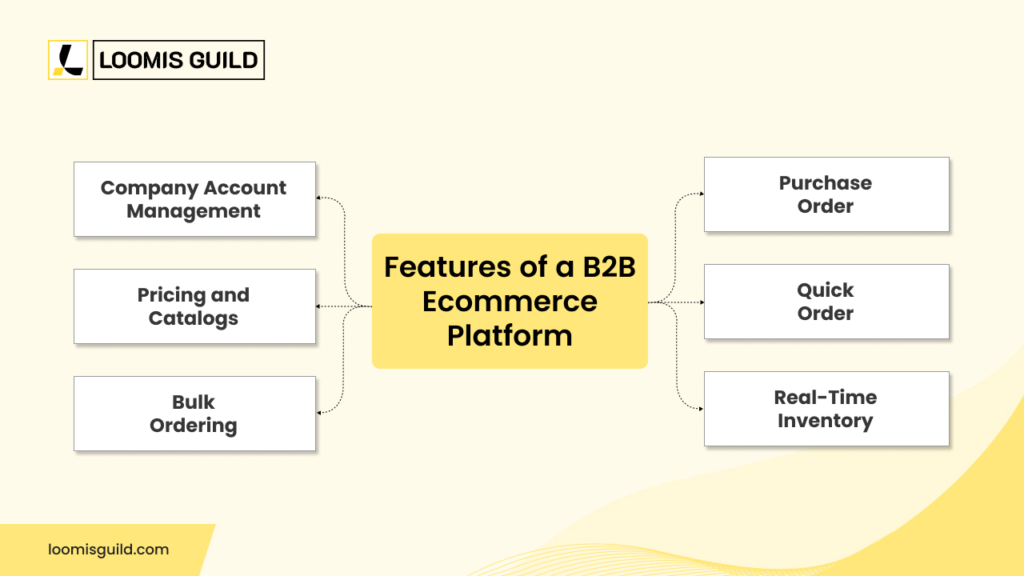
Not all ecommerce platforms are created for B2B aspects. When considering a B2B ecommerce store, always have an Ecommerce consultant agency to create for you, these are essential features that should be available:
B2B purchasing is a multi-stakeholder process with each stakeholder having different permissions: procurement managers, budget holders, and requisitioners. The platform should enable multi-user company accounts, have order approval routing where orders exceed certain thresholds, and granular role-based access control.
There are different contract prices for different accounts. With a manufacturer selling to a distributor, and a retailer selling to a government buyer, it’s a matter of having three different pricing structures, and that’s just for three SKUs. A well-designed B2B platform identifies the right price and catalog for every authenticated buyer, not a generic list price for all buyers.
Typical B2B requirements are minimum order quantities, unit of measure logic, case pack pricing, and volume discount tiers. These should be structured into the product pages, cart, and checkout, not simply added as workarounds.
Many B2B deals are done on a purchase order with net 30, 60, or 90 days payment terms. You must have native PO support, credit limit validation to your ERP, and a checkout flow that does not require the business buyer to go through a consumer checkout gateway.
B2B buyers tend to go back to the same SKUs time after time. Quick order forms (enter SKU + quantity), one-click reorder from order history, and saved order templates are conversion features, not nice-to-have features.
Your buyers should be able to see orders, view invoices, add delivery addresses, update your contacts, and return items without having to contact your sales team. With a self-serve portal, the cost of sales comes down while the satisfaction of the buyer goes up.
A B2B experience of showing inventory that’s four hours off is a trust-breaker. For advanced buyers, real-time inventory visibility is a minimum requirement, particularly when they have multiple warehouse sites.
Growing businesses often need to build a platform with an in-house ecommerce team or a white-label agency. The solution depends on where your mediocre skills are.
If your commercial enterprise is in manufacturing, distribution, wholesaling, or business offerings, then hire headless commerce tools development company will provide final results faster and at a reduced overall cost.
Platform Enhancement: The agency knows platform capabilities and your business needs.
Pre-built Integration: They integrate ERPs, CRM, and payment gateways without complexity.
B2B UX Knowledge: They understand the purchase behavior and understand IA, navigation, design, and features to be included.
Post Launch: The B2B platform needs continuous optimization with structured support and capacity
Most B2B eCommerce fails due to bad agency choice, like coding before planning, or optimizing before statistical level consistency. Each of those six ranges builds in turn on the previous one.
Stage 1: Strategy and Market Discovery
Check out the industrial market before you touch the code. Research your shoppers’ contemporary buying friction, map their digital journeys, and describe your top 20 ought-to-have features.
Goal: A clean “business brief” covering sales goals, buyer personas, and record ecosystems. Skipping this level typically forces a costly re-stage within 24 months.
Stage 2: Platform and Technical Selection
Choose your platform architecture based on information efficiency, not just features. Evaluate how the ecommerce platform handles complex pricing, multi-user corporate accounts, high SKU volumes, and API connectivity for your ERP.
Goal: Choose an infrastructure that helps your enterprise in the long run without requiring high-priced, bloated custom code for basic B2B trivia.
Stage 3: Core Build and Systems Integration
Create buyer transactions with the storefront while simultaneously integrating your back office structures (ERP, CRM, PIM).
Goal: Real-time schedule synchronization, buyer-specific contract pricing at check-in, and automated credit restrictions checking at checkout are mandatory operational baselines, no longer mandatory add-ons
Stage 4: Launch and Buyer Adoption
Your Ecommerce platform is only a hit if customers use it. Start quietly with a small, managed organization of 10 to 20 valuable existing accounts.
Goal: Gather initial notes and resolve checkout errors. Provide committed onboarding assistance to these early procurement teams for stable individual adoption before the general public begins.
Step 5: Performance & Conversion Optimization
With real transaction statistics, focus on the fine-tuning of your Ecommerce platform. Optimize your site speed (Core Web Vitals) and run an A/B test on high-value B2B movements like quick order paperwork, SKU bulk uploads, and reorder buttons.
Goal: Drive organic site visitors by using the optimization of your technical specialty papers and product categories for long-tail buying and search queries.
Step 6: Expansion and Scaling
Once your foundational operations are running, focus on scaling your business. Use this stage to combine AI tools to roll out multi-local storefronts, promote to global markets, or for predictive reordering.
Goal: Scale your reach. If your marketplace allows access, keep in mind inviting third-party providers to build a marketplace network effect on top of your existing infrastructure.
1. Verify B2B expertise – Check out the company accounts and communication with B2B companies
2. Demand B2B case studies – Look for case studies with manufacturers, distributors, and wholesalers with real data and solved complications.
3. The Integration skills – Know the integration skills and knowledge in the discovery call itself.
4. Audit their discovery process – They can map out the workflow per the platform requirements.
5. Confirm the post-launch SLA – Confirm the essential infrastructure of the live projects to know the website status.
6. Look for transparent pricing – An e-commerce agency should be able to provide the budget and costing as per the B2B scoping experience.
B2B ecommerce is never a website project. It is an investment in your business’s commercial infrastructure that will impact your customers’ interactions with your business for years to come. How quickly your sales team can grow, how efficient your operations are, and how loyal your accounts are all depend on the Ecommerce platform you create.
Partnering with a specialist B2B ecommerce development agency in India that understands the complexity of B2B buying, pricing, workflows, integration, and multi-stakeholder account management is the single decision that defines whether the investment pays off.
Loomis Guild builds B2B e-commerce platforms, marketplaces, and buyer portals to handle real operations. If you are planning to build, re-platform, or expand into a marketplace, let’s talk about the right foundation to look for your business with ease.
let’s build something great
Tell us about your project and our ecommerce specialists will get back to you with clear next steps.
Complete the form and we’ll be in touch shortly.