
Shopify Development
Shopify B2B Ecommerce Development: Features, Limits and Pricing Guide

Divyesh Kachhadiya
 21, August, 2026
Shopify Development
Divyesh Kachhadiya
21, August, 2026
Let’s discuss how Loomis Guild can design and scale an eCommerce experience built for long-term growth. Start a conversation with Loomis Guild and take the next step toward a refined, scalable eCommerce platform.
"*" indicates required fields
Divyesh Kachhadiya
Divyesh is an Ecommerce Expert with custom store builds, theme development and migration. He is experienced Ecommerce developer sharing his insights for the ecommerce store development.
Quick Summary: Shopify supports B2B selling (company accounts, catalogs, custom pricing) on all paid plans, but complex needs like contract pricing, approval workflows, and ERP integration require custom development. Shopify Plus offers higher ceilings, including unlimited catalogs and partial payments. Costs vary by integration complexity, and wholesalers versus manufacturers need distinct workflows, with custom development ensuring accurate ERP, CRM, and inventory sync.
Selling to other businesses is not the same as selling to individual shoppers. A wholesale buyer usually needs customer-specific pricing, a company account with multiple approved buyers, purchase orders, approval workflows, bulk ordering, easy reordering, a catalogue built for their account, and a connection back to your ERP. A DTC storefront was never built to handle all of this on its own.
This is exactly the gap that shopify b2b ecommerce development addresses. Shopify now ships with native B2B functionality, but turning that functionality into a working wholesale operation still takes planning, configuration, and often custom development. Here is what businesses considering this route should know.
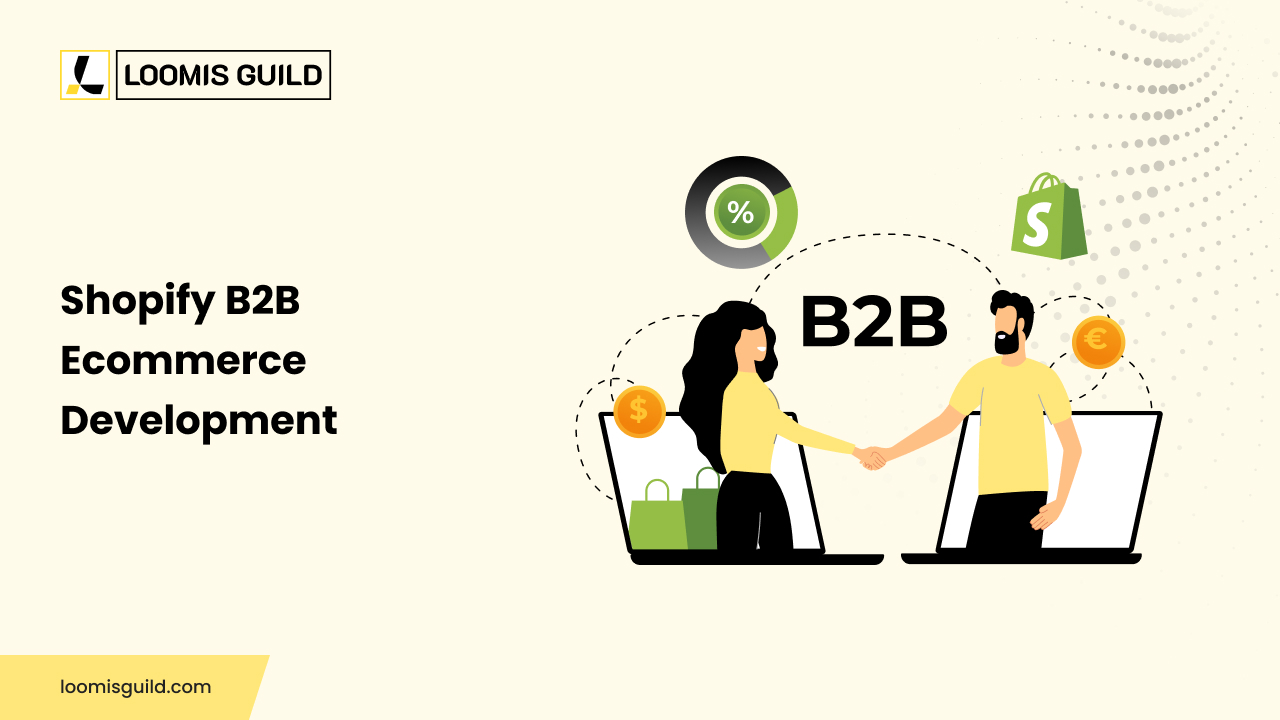
Shopify B2B is a set of native features that let a merchant sell to companies rather than only to individual consumers, using company accounts, custom catalogs, and negotiated pricing inside the same store as their regular Shopify admin. Instead of running a separate wholesale site, a business can serve DTC and B2B customers from one platform, with pricing and product visibility that change automatically based on who is logged in.
This is a meaningful shift for businesses moving away from spreadsheets, phone orders, and manual quotes. Shopify B2B ecommerce development focuses less on generic storefront design and more on how ordering, pricing, and approvals actually work inside a company. A distributor placing a repeat order should not see the same experience as a first-time retail shopper, and Shopify’s B2B tools are built around that distinction.
Shopify B2B is a suite of features that allows merchants to sell business-to-business through the Shopify admin and online store, and it is available on all Shopify plans. The features that matter most to a growing wholesale operation include: Shopify Help Center
Company profiles and locations: A company account can represent a business with several physical locations, each with its own buyers, pricing, and shipping details. This matters for a manufacturer selling into dealers across multiple regions.
Multiple buyers per account: Larger businesses often have several employees placing orders on behalf of the same company. Shopify allows multiple buyers under one company profile, each with defined permissions.
Custom catalogs and pricing: Catalogs control which products a company sees, while price lists control what they pay. A manufacturer could show one catalog to distributors and a different catalog, at different prices, to direct business customers.
Quantity rules and payment terms: Businesses can set minimum order quantities, case pack rules, and net payment terms such as Net 30, so buyers can order on credit rather than paying upfront every time.
Quick order lists and reordering: Buyers who already know their SKUs should not have to click through individual product pages. A spreadsheet-style ordering screen speeds up repeat purchases considerably.
B2B checkout and purchase orders: The checkout experience accepts purchase order numbers and vaulted payment methods, which fits how most businesses actually approve and pay for orders.
Shopify Plus B2B remains relevant even though core B2B functionality is no longer exclusive to it. As of April 2026, Shopify extended native B2B features to the Basic, Grow, and Advanced plans, so businesses no longer need Shopify Plus just to create company accounts or set net terms. What Shopify Plus still adds is scale and flexibility.
On the Basic, Grow, and Advanced plans, a business can assign up to three active catalogs across its B2B markets, while Shopify Plus allows unlimited B2B market catalogs. Shopify Plus also allows catalogs to be assigned directly to individual companies and locations for account-level pricing, rather than only through market-level assignment. For businesses with a handful of key accounts needing unique pricing, or dozens of dealer tiers, this difference becomes important quite quickly. A business with straightforward wholesale pricing could manage well on a lower plan, whereas one running complex contract pricing across many accounts should evaluate Shopify Plus B2B more seriously.
Shopify b2b ecommerce for wholesalers usually centres on repeat purchasing rather than discovery. Wholesale buyers tend to know exactly what they want and order it on a predictable cycle, so the priority is speed and accuracy rather than merchandising.
A well-configured setup could include a wholesale catalog separated from retail products, customer-specific pricing tied to each account, minimum order quantities, and a quick order screen for fast reordering. Sales representatives may also need visibility into customer accounts to place orders on a buyer’s behalf. None of this looks the same for every wholesaler, though, since a distributor selling a few hundred SKUs to a handful of accounts has very different needs from one managing thousands of SKUs across regional territories. Inventory visibility and ERP or inventory system integration often become necessary once order volume grows past what manual stock checks can support.
Shopify b2b ecommerce for manufacturers usually involves a more layered account structure than wholesale reselling alone. A manufacturer may sell to distributors at one price, dealers at another, and occasionally direct to large business customers at a third rate, all through the same store.
Product variants, custom specifications, and contract pricing tend to be more common here, and backend processes are often more complex than the storefront itself. Manufacturers frequently need their Shopify store connected to an ERP system for inventory accuracy, order routing, and production planning, which is one reason ecommerce integration and automation work matters as much as the storefront build.
There is no single number that answers what shopify b2b ecommerce development costs, because the Shopify subscription and the development work are two separate costs. The subscription covers platform access. Development covers everything needed to make the platform work for a specific business.
Factors that influence cost include the Shopify plan chosen, whether Shopify Plus is required, theme design and customization, custom B2B functionality beyond native features, catalog and pricing configuration, ERP and CRM integration, inventory system connections, data migration from an existing system, product catalog complexity, custom apps, third-party app licensing, testing, staff training, and ongoing support. A business migrating thousands of SKUs and years of order history from a legacy system will naturally involve more work than one starting fresh with a simple catalog. It helps to review Shopify store cost factors separately from B2B-specific development, since combining them into a single vague figure rarely provides an accurate picture.
A standard DTC Shopify build focuses on individual shoppers, public pricing, a simple checkout, and marketing-led purchasing. B2B ecommerce development otherwise has to account for company accounts, negotiated pricing, bulk ordering, repeat purchase patterns, multiple buyers per account, payment terms, approval workflows, and integration with operational systems like ERP or CRM.
This is a nice way to think about the difference: DTC development is largely about presentation and conversion, while B2B development is about replicating how a company already does business, only faster and with fewer manual steps. That difference is exactly why B2B implementation could require more upfront planning than a typical storefront project.
A business should consider professional Shopify B2B ecommerce development services when its wholesale process is still mostly manual, when different customers require different pricing that spreadsheets can no longer track cleanly, or when ERP integration is required to keep inventory and orders accurate.
It is very interestingly common for businesses to reach this point while scaling, once sales representatives need account-specific ordering tools, an existing store cannot support company accounts or catalogs, or the business is migrating from another B2B platform entirely. A practical guide to building a B2B ecommerce site can be a useful starting point before committing to a full build, particularly for teams weighing how much custom work their catalog and pricing structure will actually need.
Planning a Shopify B2B build is easier with a Shopify ecommerce agency for B2B and a clear picture of what your existing wholesale process actually needs, rather than starting from a generic feature list. If you are weighing up company accounts, catalog structure, or ERP integration for your store, our Shopify development services team can help map out what applies to your business. Get in touch through our Contact Us page to start that conversation.
let’s build something great
Tell us about your project and our ecommerce specialists will get back to you with clear next steps.
Complete the form and we’ll be in touch shortly.