
Shopify Development
Shopify Ecommerce Development for Automotive Brands: A Practical 2026 Guide

Divyesh Kachhadiya
 11, August, 2026
Shopify Development
Divyesh Kachhadiya
11, August, 2026
Let’s discuss how Loomis Guild can design and scale an eCommerce experience built for long-term growth. Start a conversation with Loomis Guild and take the next step toward a refined, scalable eCommerce platform.
"*" indicates required fields
Divyesh Kachhadiya
Divyesh is an Ecommerce Expert with custom store builds, theme development and migration. He is experienced Ecommerce developer sharing his insights for the ecommerce store development.
Quick Summary: Shopify automotive ecommerce works well as a commerce foundation, but automotive brands typically need fitment search, accurate product data, ERP and inventory integrations, and B2B ordering layered on top. Native Shopify features cover much of this; complex catalogs, VIN workflows and ACES/PIES data usually require custom Shopify development.
Automotive brands selling parts and accessories online face a problem most ecommerce platforms were never built to solve: a single product often fits only some vehicles, not all of them. A brake rotor that works on a 2019 Honda Civic will not fit a 2021 Ford F-150, and getting that match wrong creates returns, refunds and lost trust. This is why automotive ecommerce is more technically demanding than standard retail, involving fitment data, large catalogs, multiple customer types and system integrations. This guide explains where Shopify fits into that picture, and where Shopify ecommerce development for automotive brands needs to go beyond default configuration.
Most retail products sell to anyone who wants them. Automotive parts sell to a specific vehicle, or they don’t sell at all. That single fact changes the technical requirements of the store.
A part number rarely tells the whole story. The same physical component can carry different fitment depending on engine size, trim level, drive type or production date, so product data has to track vehicle compatibility alongside the usual details like price and dimensions. Catalogs also tend to be large: a mid-sized aftermarket parts supplier can easily list tens of thousands of SKUs once every fitment variation is counted separately.
Incorrect fitment is one of the biggest drivers of returns in this category, because a customer who selects the wrong part based on a vague description has no reliable way to know it won’t fit until it arrives. On top of this, many automotive sellers serve more than one customer type at once: individual consumers buying one part at a time, and wholesale buyers such as repair shops, dealers or distributors ordering in volume with negotiated pricing. Supporting both from a single storefront, with accurate multi-warehouse or multi-supplier inventory, is where automotive ecommerce solutions start to differ meaningfully from a standard Shopify build.
Shopify is a strong option for many automotive brands because it combines a flexible storefront, scalable infrastructure and a large ecosystem for extending functionality. The best ecommerce software for automotive retailers also depends on factors such as catalog size, fitment complexity, B2B requirements, integrations and business scale.
Other platforms such as BigCommerce, Adobe Commerce and WooCommerce can also work well depending on the business model. The right choice should be based on your operational requirements and customer journey rather than simply choosing the platform with the longest feature list.
Shopify supports a wide range of automotive product categories, though requirements vary by category rather than being identical across the board:
A wheel and tyre retailer, for example, needs precise fitment by bolt pattern and offset, while an exterior accessories brand may rely more on general vehicle make and model matching. A commercial vehicle parts supplier is more likely to need heavy B2B functionality than a DTC accessories brand. Treating every automotive category as if it has the same technical needs is a common planning mistake.
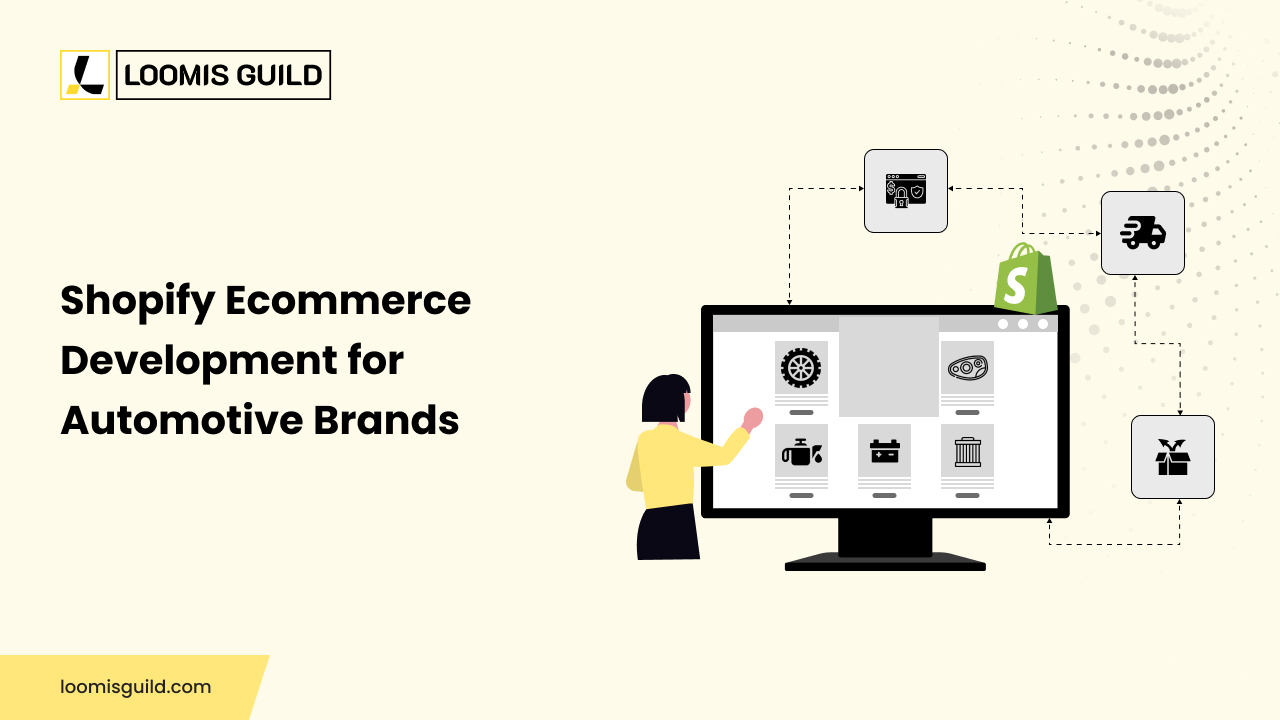
Shopify provides a strong base layer for automotive ecommerce: product and collection management, mobile-optimized checkout, built-in search, multiple sales channels, international selling through Shopify Markets, and an extensive API surface through the Shopify GraphQL Admin API for connecting external systems.
What Shopify does not do natively is automotive-specific work. It does not ship with a vehicle fitment engine, VIN decoding or built-in ACES/PIES catalog support. Shopify can support automotive ecommerce, but features such as vehicle fitment, VIN lookup and ACES/PIES catalog management typically require apps, external data providers, integrations, or custom development, depending on the store’s catalog size and complexity. This distinction matters when evaluating automotive ecommerce software, since “Shopify supports automotive” and “Shopify natively includes automotive features” are not the same claim.
A customer looking for a brake pad does not want to browse hundreds of products and guess compatibility. A Year/Make/Model (YMM) selector narrows the catalog to parts that match the selected vehicle, reducing friction and helping prevent incorrect purchases before checkout.
A Vehicle Identification Number (VIN) encodes exact build details, including engine variant and trim, that year, make and model alone cannot capture. VIN-based lookup is useful when a category has many sub-variants of the same model year, where YMM selection alone leaves ambiguity.
ACES (Aftermarket Catalog Exchange Standard) structures vehicle fitment data, while PIES (Product Information Exchange Standard) structures product attributes, descriptions and digital assets. Both are maintained by the Auto Care Association and used widely across the aftermarket parts industry. Shopify does not natively process ACES/PIES files, so businesses working with these standards generally need a data mapping process, a specialised app, or custom development to bring that data into Shopify’s product and metafield structure correctly.
Automotive shoppers filter differently than typical retail shoppers. Useful filters include vehicle, make, model, year, engine, part number, brand, product type, price and specification-based attributes such as size or material.
When products ship from multiple warehouses, suppliers or drop-ship partners, inventory accuracy directly affects customer trust. Selling a part that is actually out of stock at the supplier creates cancellations and support overhead, so inventory synchronization between Shopify and external systems is a core requirement, not an optional extra.
Automotive buyers often compare similar parts before purchasing, particularly for performance or premium components. A comparison view that lines up specifications side by side helps shoppers choose with confidence.
Specifications, installation guidance, compatibility notes, dimensions, materials, certifications and downloadable documents (such as install sheets) reduce pre-purchase questions and post-purchase returns.
An automotive Shopify store rarely operates in isolation. Common integrations include:
These connections are usually built through Shopify’s APIs rather than manual data entry, since automotive catalogs change too frequently and are too large for manual syncing to remain accurate.
Shopify for auto parts ecommerce has to account for buyers who don’t behave the same way twice: a one-time DIY customer and a repair shop reordering the same brake pads every month need different pricing views and checkout flows. Automotive sellers commonly serve four overlapping audiences: direct-to-consumer buyers, wholesale accounts, distributors, and dealers or retailers. Each has different expectations around pricing visibility, payment terms and ordering workflow.
As of April 2026, Shopify expanded its native B2B capabilities beyond Shopify Plus, bringing company profiles, custom pricing catalogs, volume pricing, net payment terms and B2B checkout to the Basic, Grow and Advanced plans at no extra cost. This shifted the practical decision point: many mid-sized wholesale operations, such as a business managing a modest number of buyer segments with standard net terms, can now run on Shopify’s core plans.
Shopify Plus still provides capabilities the other plans don’t, according to Shopify’s official plan-feature documentation: unlimited B2B catalogs versus a limit of three active catalogs on Basic, Grow and Advanced, direct catalog assignment to individual companies and locations rather than only through Markets, and advanced payment options such as deposits and partial payments. A business with many distinct pricing tiers, complex approval workflows, or account-specific catalogs is more likely to need Plus. A business with a handful of wholesale segments and standard terms may not.
Choosing between plans is really a question of how the automotive ecommerce software needs to scale over the next few years, not just what fits the current order volume.
Standard Shopify configuration and apps solve a large share of automotive ecommerce needs, but certain situations consistently require custom Shopify development for automotive brands:
Custom development should solve a defined business problem rather than be added for its own sake. A development partner like Loomis Guild typically starts by mapping these requirements against Shopify’s native capabilities before recommending where custom work is actually justified.
Shopify can also support car dealerships looking to build a modern online buying and lead-generation experience. Loomis Guild builds dealership website to showcase vehicle inventory, specifications, images, financing information, test-drive requests and enquiry forms while connecting with CRM and inventory systems.
Unlike an auto parts store, a car dealership usually needs a stronger focus on lead generation and vehicle discovery rather than instant checkout. With the right architecture, Shopify can serve as the commerce and customer experience layer while dealership systems manage the operational side.
Evaluating a partner for Shopify development for automotive brands should be better than regular Shopify experience. Useful criteria include:
Hire Shopify developer to add the most value by understanding both sides of the problem: how Shopify actually works, and how automotive catalogs, fitment and B2B ordering behave in practice. The right Shopify partner treats automotive ecommerce solutions as a combination of platform configuration, data architecture and integration work, rather than a single Shopify theme setup.
Automotive ecommerce carries requirements that ordinary retail platforms don’t need to solve: fitment accuracy, large and attribute-heavy catalogs, multi-source inventory, and support for both consumer and wholesale buyers. Shopify provides a capable commerce foundation for this, and its 2026 B2B expansion has made native wholesale functionality accessible well beyond Shopify Plus.
Loomis Guild focus on building Shopify experiences that connect storefront design with the data, systems and workflows behind automotive ecommerce. Getting the details right, fitment data, product information, inventory accuracy and system integrations, requires planning before development starts. Custom Shopify development can extend the platform to handle ACES/PIES data, VIN workflows, complex pricing and ERP connections where they’re genuinely needed. Choosing the right implementation strategy matters more than choosing a platform alone.
If your business is evaluating Shopify ecommerce development for automotive brands, Loomis Guild can help think through fitment, catalog architecture and integration requirements before committing to a build. Schedule a call today!

let’s build something great
Tell us about your project and our ecommerce specialists will get back to you with clear next steps.
Complete the form and we’ll be in touch shortly.