
Technology
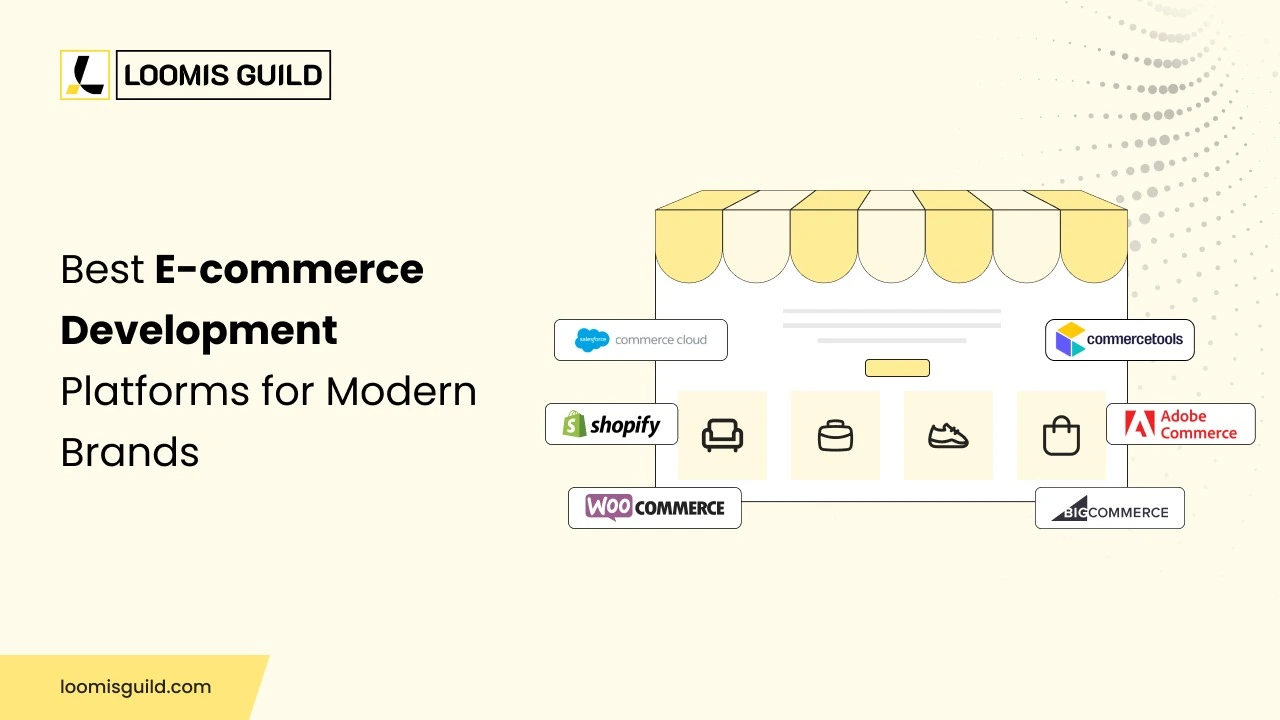
Best Ecommerce Development Platforms for Modern Brands

Divyesh Kachhadiya
 19, March, 2026
Technology
Divyesh Kachhadiya
19, March, 2026
Let’s discuss how Loomis Guild can design and scale an eCommerce experience built for long-term growth. Start a conversation with Loomis Guild and take the next step toward a refined, scalable eCommerce platform.
"*" indicates required fields
Divyesh Kachhadiya
Divyesh is an Ecommerce Expert with custom store builds, theme development and migration. He is experienced Ecommerce developer sharing his insights for the ecommerce store development.
Quick Summary: Choosing the right ecommerce platform can shape how easily your brand grows, customizes experiences, manages integrations, and supports future growth. This blog compares Shopify, Adobe Commerce, Salesforce Commerce Cloud, CommerceTools, BigCommerce, and WooCommerce based on pricing, flexibility, development complexity, scalability, and business fit, helping modern brands choose a platform that best suits their goals rather than chasing a one-size-fits-all solution.
Let’s be honest. Selecting an ecommerce platform in 2026 cannot be decided by creating a free trial and considering it done. The stakes are higher now. The consumers have changed their expectations. Business Margins are tighter. And the difference between a platform that scales your brand and one that charges your brand millions in fees, months of re-platforming headaches, and a staff that is always developing workarounds rather than the business.
Competitor brands are running through channels, geographies, and business models simultaneously. Ecommerce Development Platform is perfectly suited to a D2C skincare brand will fail when the same brand attempts to integrate a wholesale B2B portal, a local German storefront with tailored tax logic, and a headless mobile app. They are no longer edge cases. This is how contemporary business is conducted.
That is why this guide is not going to tell you that Shopify app development is the best and leave it at that. Instead, we will tour the six platforms that brands actually use, see what they do well and where they do not, their real costs (with real pricing disclosure), and which type of business should be on which platform. Then we will present you with a decision structure without having to trust a vendor.
You may be starting a new brand, moving off legacy infrastructure, or just considering what to do with a complex enterprise implementation, but this is the guide you really want.
Shopify is one of the most used ecommerce platforms in the Market and rightfully so. It provides a quick route to launching a brand, a refined backend experience, an extensive and open app platform, and a hosted infrastructure that eliminates much of the operational burden. Shopify is also open to worldwide business, B2B, omnichannel, and an expanding collection of developer applications and API. According to Shopify, each plan includes unlimited secure ecommerce hosting.
For startups in 2026, Shopify is the simplest way to get a stable ecommerce platform without building everything from scratch.
Formerly known as Magento Commerce, Adobe Commerce is designed to support the more complex commerce needs of a brand. Adobe makes it a cloud-native, composable ecommerce platform for global, multi-brand B2C and B2B experiences.
It has a reputation for maintaining a high level of catalog, advanced merchandising, multiple storefronts, and extensive customization. Another point Adobe makes is millions of SKUs, international growth from a single site, and B2B functions, including company accounts, quotes, requisition lists, and credit payments.
Adobe Commerce Development Services is commonly selected when business regulations, information formats, and customer experiences are overly layered on top of other, less complex systems.
Custom (GMV-based) Check Adobe Commerce Pricing
Salesforce Commerce Cloud is an enterprise commerce solution designed for brands that want their commerce tightly integrated with a broader customer ecosystem. The commerce offering from Salesforce is placed in the context of a broader platform of integration that includes ecommerce, order management, customer data, service, and AI-powered experiences.
This is particularly interesting to businesses already utilizing Salesforce Development Services in the sales, service, marketing, or customer data.
Revenue-share based (GMV %), typically 1–3% of GMV (Salesforce Pricing)
Commercetools is one of the most recognizable composable platforms and is based on an API-first framework. The company identifies itself as an AI-first digital commerce platform for enterprise growth and provides composable commerce to businesses that want to decouple frontend and backend systems.
CommerceTools Headless Development Services is not aiming to be the simplest platform to launch. It aims to be the most versatile for brands developing contemporary commerce infrastructure.
Essentials: starts ~$500/month
Professional & Enterprise: Commercetools Pricing
BigCommerce is a solid competitor for a brand that prefers a SaaS platform with greater flexibility than entry-level ecommerce systems. The company differentiates itself as an open SaaS platform for mid-market and enterprise brands and promotes its ease of integration, multi-storefront support, international expansion, and reduced total cost of ownership.
BigCommerce Web Development often appeals to businesses that want more control and openness than a tightly managed SaaS setup, without moving all the way to a heavier enterprise or composable stack.
WooCommerce is a free ecommerce web platform built on WordPress. It provides merchants with ultimate power over their shop, data, hosting, and customization route. According to WooCommerce, it is an open-source commerce platform that gives users control over checkout, data, and costs, and allows them to choose payment methods, features, and hosting.
WooCommerce Development Services, In content-intensive brands and WordPress-intensive businesses control a big selling point.
| Ecommerce Platform | Best for | Development complexity | Scalability | Customization flexibility | Pricing on official site |
|---|---|---|---|---|---|
| Shopify | Fast growing brands, DTC, operational simplicity | Low to moderate | High | Moderate to high | Public plans available |
| Adobe Commerce | Complex catalogs, enterprise B2B and B2C, multi store | High | Very high | High | Quote based |
| Salesforce Commerce Cloud | Enterprise brands in Salesforce ecosystem | High | Very high | Moderate to high | Quote based or sales led pricing |
| Commercetools | Composable and headless enterprise commerce | High | Very high | Very high | Plan based, sales led details |
| BigCommerce | Mid market growth, B2B, multi storefront SaaS | Moderate | High | Moderate to high | Standard $39, Plus $105, Pro $399, Enterprise custom |
| WooCommerce | WordPress first brands wanting ownership and flexibility | Moderate to high | Moderate to high | High | Core is open source, total cost varies |
Rather than inquiring about the best platform, here is the easiest approach to the question.
Selection of a ecommerce development platform is one thing. The ability to create an appropriate commerce experience on this basis is what actually determines outcomes.
Loomis Guild comes in there.
Loomis Guild is a development agency focused on ecommerce that specializes in helping existing brands select, develop, optimize, and grow the right ecommerce solution for your business goals.
Our effective ecommerce agency does not simply build stores. It can enable brands to prevent costly platform errors, align business objectives with technical decisions, and build an ecommerce architecture that can grow without full reconfigurations.
This is what it means to work with a team that knows the ecommerce strategy and development implementation.
The most effective ecommerce development platform for today’s brands is not about hype. It is about fit.
Building an eCommerce Website that works brilliantly for one business can become a frustrating mismatch for another. The smartest decision comes from balancing business models, growth plans, team capability, integration needs, and technical ambition.
Shopify cannot be ignored if you are a fast-moving brand that demands simplicity and speed. In a more complex business, control might be provided by Adobe Commerce or Salesforce Commerce Cloud.
Commercetools should be taken seriously if you have a headless, composable architecture in your roadmap. To have a strong middle ground, BigCommerce is usually well-regarded. WooCommerce is a quite powerful alternative if content and ownership are the most important aspects.
The right platform supports where your brand is headed, not where it is right now.
You have a better idea about your business, the budget, catalog, functionality you need, B2B requirements and internal team capabilities. The right ecommerce platform support your current operations without unnecessary technical or financial strain.
Adobe Commerce, Shopify, BigCommerce, and Salesforce Commerce Cloud can all support B2B ecommerce, but the best option depends on the business. Adobe Commerce is often chosen for complex B2B workflows. Shopify works well for modern B2B brands that want ease of use. BigCommerce offers strong B2B flexibility, and Salesforce Commerce Cloud can fit enterprise organizations with deeper customer ecosystem needs.
let’s build something great
Tell us about your project and our ecommerce specialists will get back to you with clear next steps.
Complete the form and we’ll be in touch shortly.