
Ecommerce Platforms Built Around Your Business






Ecommerce Development Services That Understands Your Business First
We mean it when we say Loomis Guild is your trusted partner for ecommerce development in the USA. Here, every ecommerce project starts with the same questions: who the business sells to, what the product catalogue looks like, where the current store is falling short and what the business needs the platform to do over the next few years. Skipping this step is how stores end up rebuilt twice.
From there, the right approach depends on the business rather than on whichever platform is trending. A growing D2C brand, an established B2B distributor and a multi-brand retailer need different storefronts, different checkout flows and different back-end connections, even if they end up on the same platform. This is where our ecommerce development in USA work is grounded: matching the build to how the business actually operates.
On the development side, that means storefront build, custom functionality, responsive design, integrations with payment, shipping and inventory systems, and a checkout built to convert. It also means recognizing that development is not always a fresh start. A large share of our ecommerce development involves improving or migrating an existing store rather than building from zero, without losing SEO rankings, order history or product data in the process.
A store built this way is easier to extend later, whether that means new products, new markets, new integrations or simply more customers.

Ecommerce Services That Solve Real Business Problems
Custom Ecommerce Development
Ecommerce Platform Development
Ecommerce Migration
Ecommerce Integrations
B2B Ecommerce Development
Ecommerce Website Services
Awards & Accolades

Lifestyle & Fashion Brands We’ve Helped Scale
View All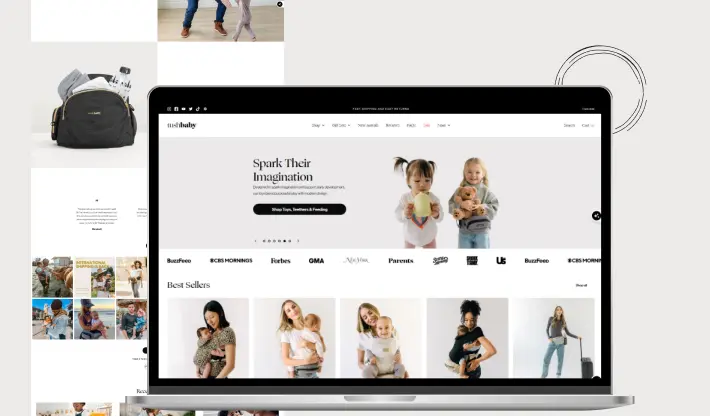
Tushbaby is a company that makes things for babies and parents. They are based in California. They sell baby carriers and diaper bags.
Tushbaby
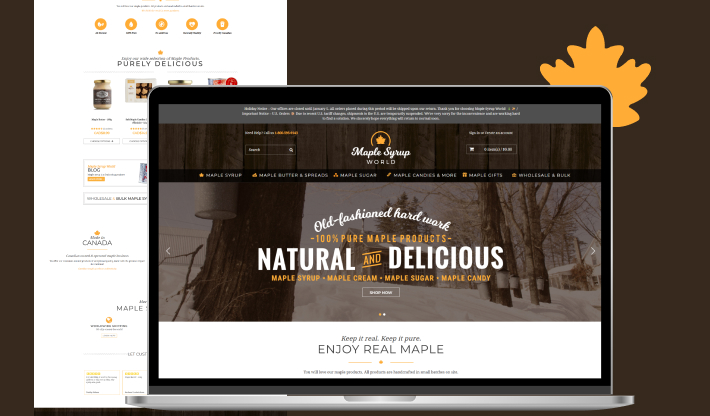
Maple Syrup World is a Canadian e-commerce brand that provides pure and handcrafted maple syrup and its products.
Maple Syrup World
Fair Reasons To Trust Team Loomis Guild
Different industries need different engagement models. We help businesses launch, improve and grow their ecommerce presence with an approach built around how each business actually operates.
1
10+ In-House Ecommerce Specialists
2
Flexible Engagement Models
3
9+ Years Ecommerce Expertise
4
95% Customer NPS
5
Deep Industry Expertise
6
200+ Projects Launched
7
End-to-End Ecommerce Partner

10+ In-House Ecommerce Specialists
A dedicated team of strategists, developers and QA specialists works on every project, rather than one generalist handling design, development and testing alone. Each part of the build gets attention from someone who specializes in it.

Flexible Engagement Models
Engagement is structured around your long-term growth rather than a single fixed package. You can work with a full team or a dedicated partner, with ongoing optimization and support built in as the relationship continues.

9+ Years Ecommerce Expertise
Nearly a decade spent building, migrating and supporting ecommerce stores across platforms and industries. That history means fewer surprises mid-project, since most technical and operational challenges a business runs into, we've already solved before.

95% Customer NPS
Most clients who work with us would recommend Loomis Guild to another business. That score reflects how projects are actually delivered and supported, not just how a store looks at launch, but how it performs afterward.

Deep Industry Expertise
Years of work across established ecommerce platforms have given us a practical understanding of customer behavior across B2C, B2B and D2C models. We bring that experience into each project instead of applying the same template to every business.
200+ Projects Launched
Stores built, migrated and scaled across B2C, B2B and D2C businesses in multiple regions. That range means we've likely already worked on a project with requirements similar to yours, whatever industry you're in.
End-to-End Ecommerce Partner
We stay involved from initial strategy through storefront development, integrations, migration and post-launch support, rather than handing off the project once the store goes live. That continuity is why clients come back for the next phase of their growth.
Ecommerce services serving through the top cities
New York
Los Angeles
Chicago
Houston
San Francisco
Miami
Frequently Asked Questions
What do ecommerce development services actually include?
It's more than building a storefront. A full ecommerce development services USA engagement typically covers platform selection, storefront design and build, product catalogue setup, third-party integrations (payment, shipping, inventory, ERP/CRM), QA and performance testing, and post-launch monitoring. Businesses that hire a developer for just the build often end up needing a second vendor for integrations and a third for ongoing support. The point of a full-service partner is not doing that three times.
What are the different types of ecommerce, and which one applies to me?
Ecommerce is generally grouped by who's transacting with whom: B2C (business to consumer), B2B (business to business), C2C (consumer to consumer, like marketplaces), C2B (consumer to business, like freelance platforms), D2C (direct to consumer, brands selling without a retail middleman), plus smaller categories like B2A/C2A involving government agencies. Most businesses looking for ecommerce development in USA work fall into B2C, B2B or D2C, and the model changes what the store needs technically: account tiers and bulk pricing for B2B, a fast checkout for B2C/D2C.
Which ecommerce platform is actually the most popular in the US right now?
Shopify holds the largest share of the US market, generally cited around 28 to 30% of ecommerce sites. WooCommerce and Wix follow, though their ranking shifts depending on whether you're counting all sites or just high-traffic ones. WooCommerce's numbers are inflated by a long tail of small WordPress stores, while Wix skews toward smaller general-purpose sites. BigCommerce and Adobe Commerce don't lead on raw site count but are the more common choice once a catalogue or B2B requirements get complex. "Most popular" and "right for you" aren't the same question. That's usually the first thing we sort out with a client.
Is there actually a "best" ecommerce platform, or does it depend on the business?
It depends on the business, and answering it in the abstract is how projects end up rebuilt within two years. Shopify and WooCommerce suit most growing D2C and small-to-mid B2C stores. BigCommerce and Adobe Commerce make more sense for larger catalogues, complex pricing, or heavy B2B requirements where the standard checkout flow isn't enough. As part of our ecommerce development solutions USA work, this is one of the first things we scope before recommending a platform, not after.
How is ecommerce development different from just picking a platform like Shopify or WooCommerce?
Signing up for Shopify or WooCommerce gets you software, not a working store. Development is everything that turns that software into something that fits your catalogue, sells the way your business actually sells, and connects to the systems you already run: payment processors, shipping carriers, inventory, ERP or CRM. This is where a lot of DIY builds fall apart. The platform works fine, but the store around it wasn't built for the business's actual order volume or product complexity.
What happens after an ecommerce store launches? Is development a one-time project?
It shouldn't be treated as one. Traffic patterns, product ranges, and platform requirements all shift after launch, and a store that isn't monitored tends to degrade quietly: slower checkout, broken integrations after a platform update, pages that stop ranking. Our ecommerce website management services cover monitoring, troubleshooting, and performance improvements after go-live, which is also usually when the store starts generating the customer data that tells you what to build next.
Do I need a different developer if I want to migrate my store to a new platform later?
No. Migration is development work, not a separate discipline, and it carries more risk than a fresh build because there's product history, SEO rankings, and order data that can't be lost in the move. Anyone doing ecommerce website development in the USA should be able to handle a migration with the same team that built the original store, since they already understand what's being preserved and why.
Let’s connect
Got a new store to build, one that's not converting, or a platform switch on your mind? We'd love to hear about it. Most people looking for the best ecommerce development company in the USA start with a quick conversation, not a formal pitch. Tell us what you're working on and we'll get back to you with clear next steps.
Need our help to Scale?

Biz@loomisguild.com

India: +91 92136 58393
Ready to chat?
Let’s discuss how Loomis Guild can design and scale an eCommerce experience built for long-term growth. Start a conversation with Loomis Guild and take the next step toward a refined, scalable eCommerce platform.
Contact Us
Contact Us