
Ecommerce website development
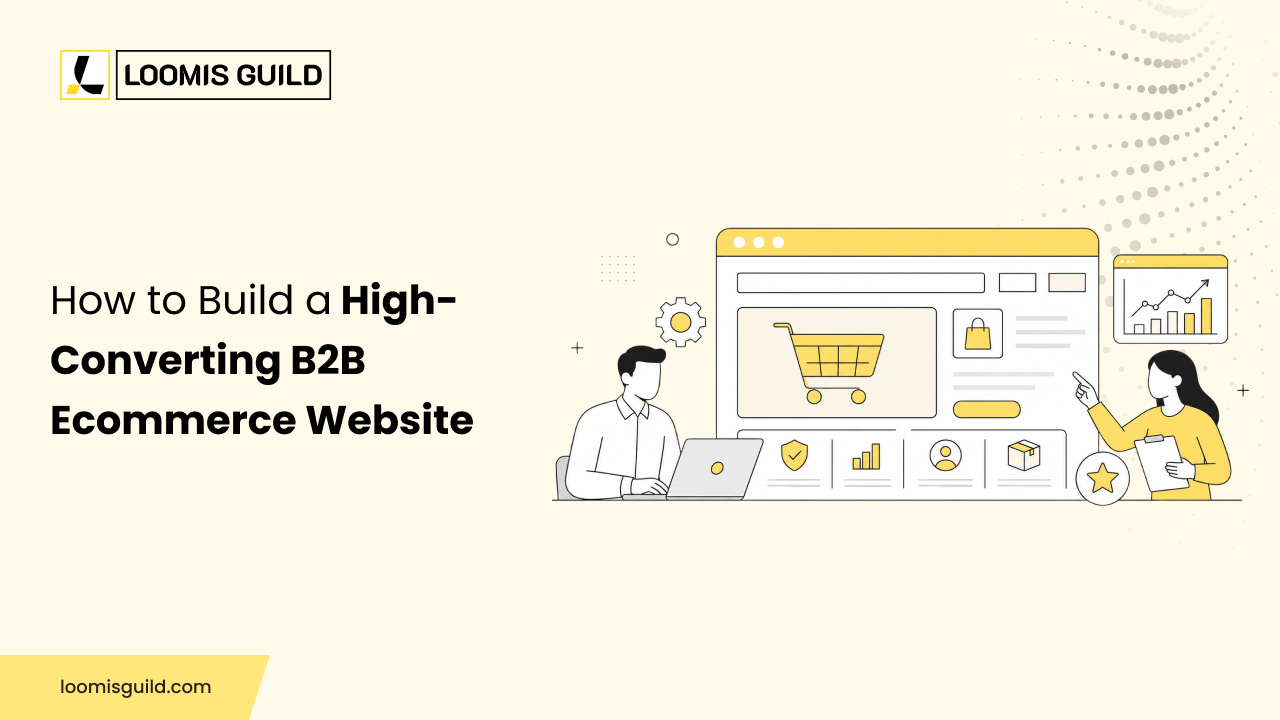
How to Build a High-Converting B2B Ecommerce Website

Divyesh Kachhadiya
 19, May, 2026
Ecommerce website development
Divyesh Kachhadiya
19, May, 2026
Let’s discuss how Loomis Guild can design and scale an eCommerce experience built for long-term growth. Start a conversation with Loomis Guild and take the next step toward a refined, scalable eCommerce platform.
"*" indicates required fields
Divyesh Kachhadiya
Divyesh is an Ecommerce Expert with custom store builds, theme development and migration. He is experienced Ecommerce developer sharing his insights for the ecommerce store development.
Quick Summary: This guide goes into the tech-based decisions which, in fact, determine if a B2B ecom site will convert at large scale, platform choice, pricing engine structure, ERP/CRM integration strategies, checkout flow design, and performance improvements. For development teams, technical heads, and business owners working with a B2B ecom dev company to build or re-platform.
Most B2B ecommerce project fail quietly. The site launches, the catalog is live, and the design looks clean in the demo. Then the real buying workflow starts, and the gaps appear. Pricing doesn’t resolve correctly for contract accounts. Purchase orders have no path through checkout. The ERP is four hours out of sync. None of these is a design problem. They are engineering and architecture problems, and they are the ones that determine whether a B2B site actually converts at scale.
This guide covers the technical decisions that matter: platform selection, pricing engine architecture, ERP and CRM integration, checkout engineering for B2B requirements, and the performance layer that drives organic acquisition. It is written for development teams, technical leads, and business owners who are building or re-platforming with a B2B ecommerce website development agency and want to get the architecture right from the start.
Platform selection is not a design decision. It is an infrastructure decision, and it determines what is feasible, what requires custom development, and what is effectively impossible without a full re-platform. Most teams underinvest in this evaluation and pay for it over the entire lifecycle of the build.
The leading B2B ecommerce development agency evaluations we see most often come down to five platforms, each with a distinct architectural fit:
| Platform Type | Best For | Architecture |
|---|---|---|
| Shopify Plus | Mid-market, fast launch | SaaS / API-first |
| Adobe Commerce | Enterprise, complex catalogs | Monolithic / Headless |
| BigCommerce B2B | Multi-storefront, wholesale | SaaS / Headless |
| WooCommerce | SMB, full code control | Open-source / Self-hosted |
| CommerceTools | MACH-native, composable builds | Headless / API-first |
For businesses with complex customer hierarchies, custom pricing per account, and high-volume procurement workflows, CommerceTools and Adobe Commerce are the architectures worth serious evaluation. For mid-market businesses needing a fast, maintainable launch with strong B2B ecommerce technology built in, Shopify Plus has matured significantly its B2B features now support company accounts, custom catalogs, net payment terms, and draft orders natively.
The most important technical question in platform selection is not feature parity; it is integration architecture. How does the platform expose APIs for your ERP? What does the data model look like for customer-specific pricing? How does it handle approval workflows? These questions surface the real constraints earlier, when changing direction costs days rather than months.
B2C checkout is simple by comparison. One price, one buyer, one transaction. B2B pricing is a completely different engineering problem: contract pricing per customer account, volume discount tiers, minimum order quantities, customer-specific catalogs that hide products not available to certain buyers, and dynamic margin rules that need to be resolved in real time during search, not just at checkout.
Building out these elements incorrectly is the primary issue that causes B2B ecom projects to fail. Price information that takes a while to load, as it is recalculated on each page view instead of being cached against the authenticated customer session, creates a visible delay, which in turn ruins the purchase experience. A well-engineered pricing system that weaves pricing and product info together, determines price at login against the user’s session, puts that in cache, and only reevaluates on account or cart change.
In practice: a distributor running 12,000 SKUs across 800 customer accounts cannot query live contract pricing on every product page load. The correct architecture caches a customer price matrix on session start and updates it incrementally. Teams that build this correctly see checkout drop-off rates fall sharply because pricing is instant and accurate throughout the buying journey.
The integration layer between your e-commerce platform and your ERP or CRM is where most B2B platforms either perform or quietly fail. There are two patterns in use: batch sync and real-time API integration. The choice between them is consequential.
Batch sync runs on a schedule, typically hourly or nightly, pushing inventory levels, pricing updates, and order status between the ecommerce platform and ERP. It is cheaper to build and easier to maintain. It is also wrong for most B2B ecommerce environments, because a buyer placing a large order on a product that went out of stock two hours ago creates a fulfillment problem that damages the customer relationship immediately.
Real-time integration uses event-driven webhooks or direct API calls to keep inventory, pricing, and order data synchronized within seconds. The build cost is higher, and the integration requires careful error handling and retry logic. But for any B2B platform processing significant order volumes, it is the only architecture that prevents the class of errors that batch sync cannot catch. Leading B2B ecommerce development agencies build real-time ERP integration as the default, not the premium option.
Standard e-commerce checkout flows are built for B2C assumptions: one buyer, one delivery address, immediate payment. B2B checkout needs to handle a different set of requirements entirely, and these need to be engineered deliberately rather than retrofitted onto a consumer checkout flow.
A significant portion of US B2B transactions, particularly in manufacturing, distribution, and wholesale, are placed on purchase order with NET 30, 60, or 90 payment terms. Your checkout must accept a PO number, validate the buyer’s available credit against the ERP in real time, and route the order into the approval workflow without blocking the buyer. This is not a payment gateway feature. It is the custom checkout logic that needs to be scoped and built.
B2B accounts typically involve multiple buyers operating under a single company account — procurement managers, department heads, and requisitioners, each with different purchasing permissions. Role-based access control at the account level, combined with order approval routing for transactions above a defined threshold, is a standard requirement in any serious B2B build. It is also one of the most commonly under-scooped features in the initial brief.
A B2B ecommerce website should be designed to facilitate business buying, business order approval, and business order management. In addition to the product display, the store should also facilitate repeat purchases and simplify the management of business accounts.
The right features will depend on your sales process, your customers’ needs, and your current business processes. Focus on attributes that streamline work for your team and the purchaser.
B2B buying is often highly repetitive. Buyers return for the same SKUs on regular cycles. Reorder functionality, one-click reorder from order history, saved order templates, and standing order schedules directly reduces friction for repeat purchases, which represent the majority of B2B revenue. This should be treated as a core checkout feature, not a phase-two enhancement.
A B2B e-commerce site that reports in under 2 seconds will outperform one that does so in four seconds. Google’s Core Web Vitals, Largest Contentful Paint under 2.5 seconds, Cumulative Layout Shift under 0.1, and Interaction to Next Paint under 200ms are what also rank by and which we use as UX benchmarks. In B2B, we see that organic search is a large driver of new account growth, which is a priority pre-launch and not something to address post-launch.
B2B e-commerce development agency see the trend of front-end and back-end commerce via REST or GraphQL APIs, which is the main tech strategy used by leaders in the field to improve Core Web Vitals. We see React, Next.js, or Vue.js frontends which are hosted on CDNs with server-side rendering, which traditional server render commerce can’t achieve at that large a scale. The tradeoff is more complex builds and a larger need for engineering teams.
Timelines depend on scope and platform. A Shopify Plus B2B build with standard integrations typically takes 10 to 16 weeks. An Adobe Commerce or CommerceTools implementation with custom pricing logic and ERP integration runs 4 to 9 months. The most common cause of overruns is integration scope that was not fully defined before the build started, particularly around ERP data models and customer pricing rules.
For most mid-market B2B businesses, a well-configured platform theme with custom B2B ecommerce technology built on top performs well and is significantly cheaper to build and maintain than a headless architecture. Headless makes commercial sense when you are serving multiple frontends from one backend, running extremely high traffic volumes, or competing in a category where sub-second performance is a meaningful differentiator. If you are asking whether you need it, you probably do not yet.

let’s build something great
Tell us about your project and our ecommerce specialists will get back to you with clear next steps.
Complete the form and we’ll be in touch shortly.