
WooCommerce Development
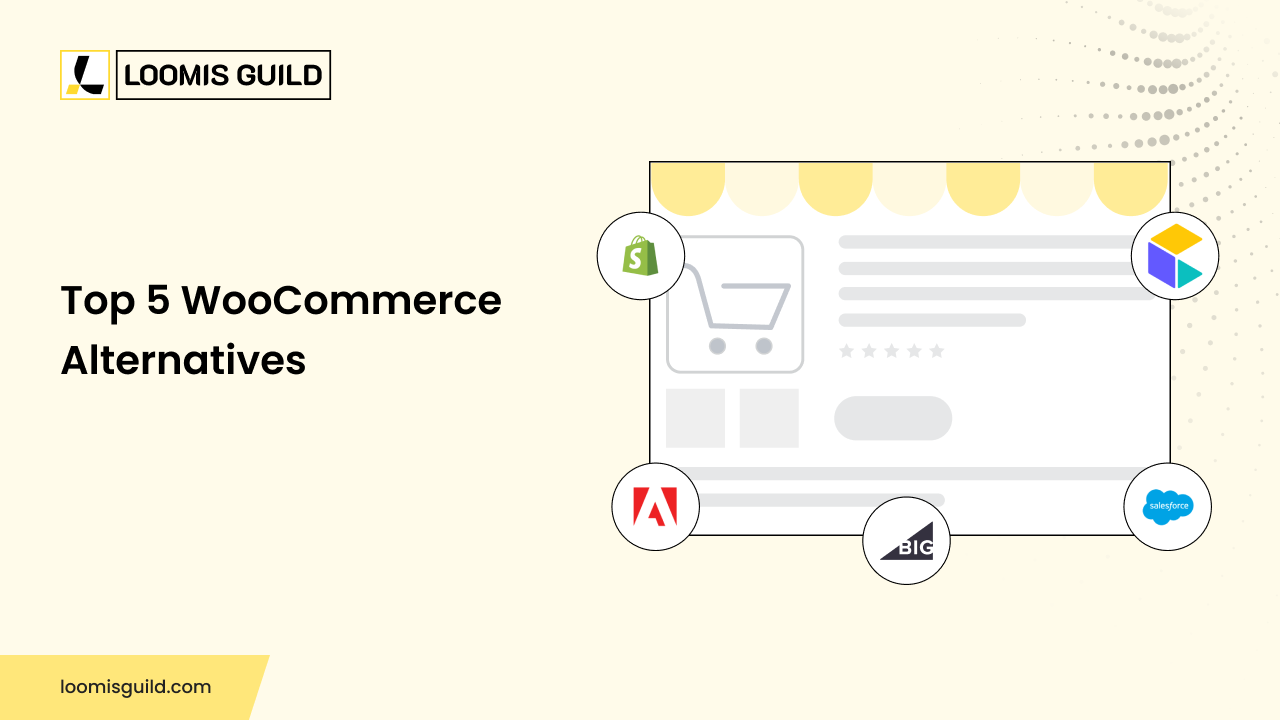
Top 5 WooCommerce Alternatives in 2026

Divyesh Kachhadiya
 21, April, 2026
WooCommerce Development
Divyesh Kachhadiya
21, April, 2026
Let’s discuss how Loomis Guild can design and scale an eCommerce experience built for long-term growth. Start a conversation with Loomis Guild and take the next step toward a refined, scalable eCommerce platform.
"*" indicates required fields
Divyesh Kachhadiya
Divyesh is an Ecommerce Expert with custom store builds, theme development and migration. He is experienced Ecommerce developer sharing his insights for the ecommerce store development.
Quick Summary: WooCommerce is not the right fit for every business anymore. This guide breaks down five platforms that are actually worth your time in 2026. No fluff, just what each one does well and where it starts to crack under pressure. Whether you're looking at WooCommerce development services to squeeze more out of your current setup, or you're seriously thinking about a WooCommerce migration to something built for a bigger scale, the right call starts with the right information. So let's get into it.
Look, WooCommerce runs a huge chunk of online stores. But here’s the thing, popular doesn’t always mean it’s right for you.
Running WooCommerce well? It’s way more than just slapping on a plugin. You’re juggling WordPress updates, hosting headaches, plugin conflicts, and security patches, while your actual store goals collect dust. If you’re a small team trying to scale, that’s real time and real cash you’re burning.
Business owners in the USA want systems that just work. UK retailers need clean multi-market setups without the custom coding mess. Aussie merchants want speed and simplicity. In Germany, headless commerce isn’t just for big players anymore. And teams in India? They’re handling WooCommerce development, migrations for global brands that want quality without the enterprise price tag.
If you’re sitting there wondering whether to stick with WooCommerce ecommerce website builders, tweak it, or jump ship, you’re in the right place.
Sure, WooCommerce is free, open-source, and flexible. But it comes with baggage.
Every new feature? That’s another plugin. Hit twenty plugins, and you’ve got a house of cards, one update away from breaking something you didn’t see coming. Traffic spikes? You’ll need pricey hosting that WooCommerce wasn’t built to handle solo.
Then there’s the never-ending ecommerce maintenance grind: WordPress updates, theme fixes, security patches, backups. For lean teams? That stuff quietly eats hours you should be spending on actual growth.
And honestly, when your WooCommerce development company is spending more time putting out fires than building features? That’s your sign to choose from the best ecommerce platforms.
Look, if you want to skip the technical headaches and just start selling, Shopify website is the best. No server issues, no uptime anxiety, no plugin problems. It’s fully hosted, PCI-compliant, and honestly? It handles traffic spikes like it’s nothing. You don’t even have to think about it.
What it does well: A clean checkout flow, thousands of integrations, strong multi-channel support (Meta, TikTok, Amazon), and a growing AI toolkit via Shopify Magic. For headless builds, Hydrogen’s got you covered. It’s a React framework with global edge hosting via Oxygen. Fast and developer-friendly.
The tradeoffs: Transaction fees apply unless you use Shopify Payments. Deep checkout customization is mostly locked behind Shopify Plus. Content management won’t feel as flexible as WordPress. That’s the trade-off.
Best for: DTC brands, fast-growing startups, and small businesses in the USA and UK who want to launch quickly and keep maintenance light.
Pricing: Basic at $29/month, scaling to $299/month (billed annually). Plus starts around $2,300/month.
BigCommerce sits in an interesting middle ground: it gives you managed SaaS hosting while supporting the kind of architectural flexibility that WooCommerce users often demand before leaving.
What it does well: No added transaction fees from the platform ever. B2B tools? They’re baked right in tiered pricing, custom catalogs, and bulk ordering. It’s API-first, so if you’re going headless, you’re not locked into one framework.
The tradeoffs: Your plan cost goes up as revenue grows. Plus, it’s got a steeper learning curve than Shopify if you’re new to mid-market platforms.
Best for: Mid-market B2B brands and multi-channel retailers in Australia and Germany who need real scalability without transaction fees eating profits.
Pricing: Standard $39/mo, Plus $105/mo, Pro $399/mo. Enterprise is custom.
If WooCommerce is appealing because it is flexible, Adobe Commerce takes that idea and builds an entire business framework around it. Complex catalogs, multi-store setups, global tax handling, deep B2B workflows- it supports all of it at a level WooCommerce simply wasn’t built for.
What it does well: Multi-store management from one backend, AI-powered personalization via Adobe Sensei, and over 4,000 extensions. Magento Open Source is still free to download and self-host; Adobe Commerce adds cloud hosting, managed services, and enterprise support.
The tradeoffs: Adobe Commerce licensing? Tens of thousands a year, easy. You’ll need experienced devs to set it up, and engineering costs don’t stop after launch. If you don’t have a dedicated tech team, this isn’t your play.
Best for: Big enterprises and well-funded scale-ups, especially in Germany and the USA, with massive product catalogs and their own dev teams.
Pricing: Adobe Commerce starts around $22K/year. Cloud hosting? That kicks off at $40K/year.
Wix has matured considerably. What started as a basic website builder now covers inventory management, abandoned cart recovery, multichannel selling, and built-in SEO tools, all from a drag-and-drop interface that needs no developer involvement.
What it does well: Fast setup, clean templates, no transaction fees, and a genuinely approachable admin experience. For stores with simpler product catalogs and content-driven selling, it covers the bases well.
The tradeoffs: Big catalogs or heavy traffic? Performance takes a hit. Need a custom checkout? You’ll hit the ceiling pretty fast.
Best for: Solopreneurs, creatives, local shops, and early-stage startups in India and the UK launching their first legit storefront.
Pricing: $27–$159/month, depending on your plan and region.
Commercetools isn’t a traditional eCommerce platform. It’s a suite of API-first commerce services, cart, catalog, orders, and pricing that your development team assembles into a custom experience. No default frontend, no monolithic architecture, no platform constraints dictating what you can or can’t build.
What it does well: Full MACH architecture (Microservices, API-first, Cloud-native, Headless). You connect it to any frontend framework, React, Vue, Next.js, and integrate any third-party service without compromise. Pricing is order-based rather than GMV-based, which rewards scale rather than penalizing it.
The tradeoffs: Implementation timelines of three to twelve months and significant engineering investment make it inaccessible for most SMBs. This is an enterprise tool for teams with the architecture maturity to use it properly.
Best for: Enterprise teams in the USA, Germany, and Australia pulling $10M+ yearly with dedicated devs building custom commerce experiences.
Pricing: Starts around $50K/year, fully custom.
| Platform | Type | Ease of Use | Scalability | Best For | Starting Price |
|---|---|---|---|---|---|
| Shopify | SaaS | Very High | High | DTC, fast-growing brands | ~$29/mo |
| BigCommerce | SaaS | High | Very High | Mid-market, B2B | ~$39/mo |
| Adobe Commerce | Self-host / Cloud | Moderate | Enterprise | Complex B2B, large catalogs | ~$22K/year |
| Wix eCommerce | All-in-one SaaS | Very High | Medium | Small business, simple stores | ~$27/mo |
| Commercetools | Composable / Headless | Developer-focused | Enterprise | Composable, omnichannel | Custom |
Not every business should migrate. But certain signals make the case clear:
Your plugin count keeps growing, yet performance doesn’t improve. Security patches are eating developer hours that should go toward features. You’re entering new international markets and need native multi-currency, multi-language tools. Your hosting costs are scaling faster than revenue. Or your CTO is mapping a path toward headless architecture that WooCommerce’s plugin model can’t support.
Revenue thresholds matter too. Businesses consistently generating $50K or more per month often find that a WooCommerce migration to a managed platform pays for itself quickly through improved uptime, reduced maintenance overhead, and faster iteration.
A WooCommerce migration done poorly is expensive. SEO rankings drop. Customer data gets corrupted. Order history disappears. Checkout flows break in ways that aren’t obvious until post-launch.
A proper WooCommerce migration solution covers product data, customer records, and order history, but also URL mapping for SEO continuity, payment gateway re-establishment, and thorough post-launch testing. The “edges” of a migration tax configuration, discount codes, and subscription logic are where revenue risk actually lives.
Professional WooCommerce development services address these systematically. Whether you’re moving to Shopify, BigCommerce, or a composable setup like Commercetools, how you migrate matters just as much as where you land.
Loomis Guild is a Ecommerce development company based in India, working with businesses across the USA, UK, Australia, Germany, and beyond. The team covers everything from performance tuning and custom plugin development to full platform migrations.
For businesses ready to move, Loomis Guild manages the entire ecommerce migration process, including data mapping, SEO redirects, integration setup, QA, and post-launch support. The model is straightforward: India-based efficiency paired with the kind of technical quality global clients actually expect. That combination makes serious projects accessible at every stage of growth.
For most small to mid-size businesses, Shopify is the strongest option right now. It’s easy to use, dependable, and built to scale. If you’re running a B2B operation, BigCommerce tends to be a better match. Enterprises with custom requirements should explore Commercetools. The best choice really comes down to your catalog size, your team’s capabilities, and where you want to be in the next couple of years.
Time to migrate when maintenance costs spiral, site speed suffers during traffic spikes, plugin conflicts become a headache, or international expansion is on your roadmap. Most businesses recoup the investment within months of switching to a managed platform.
It depends; a simple store can move in a few weeks, but a complicated setup with custom integrations can take a few months. Having a team with experience makes the whole process go more smoothly and keeps your data safe.
let’s build something great
Tell us about your project and our ecommerce specialists will get back to you with clear next steps.
Complete the form and we’ll be in touch shortly.